Saturday, May 31, 2025

Netflix Tudum 2025 live: the biggest news about Stranger Things, One Piece, Squid Game and more

Didn't manage to get tickets to the Netflix Tudum 2025 live event? Don't worry. We'll be rounding up all the biggest news from the global fan extravaganza taking place in Los Angeles right here.

Some of the biggest returning TV shows and upcoming movies from one of the best streaming services are already confirmed to feature throughout the evening. From Stranger Things season 5 and Wednesday season 2 to Squid Game season 3 and One Piece season 2, there's a lot of ground to cover.

Alongside live performances from global stars like Lady Gaga and Hanumankind as well as appearances from some of the talent in Netflix's hit shows and movies, there'll be streaming announcements in the form of trailers, teasers, release dates and more.

We'll be covering the biggest streaming news from the event live, so you'll be able to catch up on anything you missed about the best Netflix shows and new Netflix movies all in one place. Follow along below to get the biggest news from Netflix's biggest fan event.

Where can I watch Netflix Tudum 2025?

You can tune into the Netflix Tudum 2025 live event from home by streaming it live on Netflix on May 31, 2025, at 8pm ET / 5PM PT. That means viewers in the UK can catch it at 1am BST, while those in Australia will be able to watch it at 10am AEST.

Just like any other Netflix live streaming event, you'll need a subscription to be able to get in on all the action. If you're not currently signed up to the service though (Netflix doesn't tend to feature among the best streaming deals), then you can catch up on anything you missed right here.


source https://www.techradar.com/streaming/live/netflix-tudum-2025-live

Criminals hijacking subdomains of popular websites such as Bose or Panasonic to infect victims with malware: here's how to stay safe


  • Outdated DNS records create invisible openings for criminals to spread malware through legitimate sites
  • Hazy Hawk turns misconfigured cloud links into silent redirection traps for fraud and infection
  • Victims think they’re visiting a real site, until popups and malware take over

A troubling new online threat is emerging in which criminals hijack subdomains of major organizations, such as Bose, Panasonic, and even the US CDC (Centers for Disease Control and Prevention), to spread malware and perpetrate online scams.

As flagged by security experts Infoblox, at the center of this campaign is a threat group known as Hazy Hawk, which has taken a relatively quiet but highly effective approach to compromise user trust and weaponize it against unsuspecting visitors.

These subdomain hijackings are not the result of direct hacking but rather of exploiting overlooked infrastructure vulnerabilities.

An exploit rooted in administrative oversight

Instead of breaching networks through brute force or phishing, Hazy Hawk exploits abandoned cloud resources linked to misconfigured DNS CNAME records.

These so-called “dangling” records occur when an organization decommissions a cloud service but forgets to update or delete the DNS entry pointing to it, leaving the subdomain vulnerable.

For example, a forgotten subdomain like something.bose.com might still point to an unused Azure or AWS resource, and if Hazy Hawk registers the corresponding cloud instance, the attacker suddenly controls a legitimate-looking Bose subdomain.

This method is dangerous because misconfigurations are not typically flagged by conventional security systems.

The repurposed subdomains become platforms for delivering scams, including fake antivirus warnings, tech support cons, and malware disguised as software updates.

Hazy Hawk doesn’t just stop at hijacking - the group uses traffic distribution systems (TDSs) to reroute users from hijacked subdomains to malicious destinations.

These TDSs, such as viralclipnow.xyz, assess a user’s device type, location, and browsing behavior to serve up tailored scams.

Often, redirection begins with seemingly innocuous developer or blog domains, like share.js.org, before shuffling users through a web of deception.

Once users accept push notifications, they continue to receive scam messages long after the initial infection, establishing a lasting vector for fraud.

The fallout from these campaigns is more than theoretical and has affected high-profile organizations and firms like the CDC, Panasonic and Deloitte.

Individuals can guard against these threats by refusing push notification requests from unfamiliar sites and exercising caution with links that seem too good to be true.

For organizations, the emphasis must be on DNS hygiene. Failing to remove DNS entries for decommissioned cloud services leaves subdomains vulnerable to takeover.

Automated DNS monitoring tools, especially those integrated with threat intelligence, can help detect signs of compromise.

Security teams should treat these misconfigurations as critical vulnerabilities, not minor oversights.

You might also like


source https://www.techradar.com/pro/security/criminals-hijacking-subdomains-of-popular-websites-such-as-bose-or-panasonic-to-infect-victims-with-malware-heres-how-to-stay-safe

Everything new on Paramount+ in June 2025 – including over 80 new movies to add to your watchlist

In our list of the best streaming services we crowned Paramount+ as the best platform for classic movies, and it still is – however, it's broadening its library of 21st century features in its list of new titles for June 2025.

With over 80 new movies landing on June 1, among the list of new Paramount+ movies lies modern titles that over time have earned modern classic status, starting with No Country for Old Men (2007) – a western thriller from the Coen brothers starring Javier Bardem and Josh Brolin.

But that's not all and, if anything, the drama never ends. Joining the Coens' thriller is Steve McQueen's Best Picture winner 12 Years a Slave (2013), Tarantino's Pulp Fiction (1994), and four movies from the Indiana Jones franchise. The thrills are endless.

Everything new on Paramount+ in June 2025

Arriving on June 1

3:10 to Yuma (movie)
12 Years a Slave
(movie)
Bad News Bears
(movie)
BlacKkKlansman
(movie)
Boogie Nights
(movie)
But I'm a Cheerleader
(movie)
Call Me By Your Name
(movie)
Carol
(movie)
Carriers
(movie)
Center Stage
(movie)
Changing Lanes
(movie)
Chasing Amy
(movie)
Cloverfield (movie)
Crawlspace
(movie)
Daddy Day Camp
(movie)
Dance Flick
(movie)
Dog Day Afternoon
(movie)
Double Jeopardy
(movie)
Eagle Eye
(movie)
Elf
(movie)
Enemy at the Gates
(movie)
EuroTrip
(movie)
Everybody's Fine
(movie)
Extract
(movie)
First Blood
(movie)
Heatwave
(movie)
How She Move
(movie)
How to Lose a Guy in 10 Days
(movie)
Imagine That
(movie)
In & Out
(movie)
Indiana Jones and the Kingdom of the Crystal Skull
(movie)
Indiana Jones and the Last Crusade
(movie)
Indiana Jones and the Raiders of the Lost Ark
(movie)
Indiana Jones and the Temple of Doom
(movie)
Jawbreaker
(movie)
Kinky Boots
(movie)
Law of Desire
(movie)
Layer Cake
(movie)
Light of My Life
(movie)
Like a Boss
(movie)
Marathon Man
(movie)
Masterminds
(movie)
Military Wives
(movie)
Naked Gun 33 1/3: The Final Insult
(movie)
No Country for Old Men
(movie)
Orange County
(movie)
Overdrive
(movie)
Pretty In Pink
(movie)
Pulp Fiction
(movie)
Racing with the Moon
(movie)
Rambo III
(movie)
Rambo: First Blood Part II
(movie)
RED
(movie)
Reservoir Dogs
(movie)
Risky Business
(movie)
Road Trip
(movie)
Run & Gun
(movie)
Saturday Night Fever
(movie)
Save the Last Dance
(movie)
School Ties
(movie)
Scouts Guide to the Zombie Apocalypse
(movie)
She's All That
(movie)
Sky Captain and the World of Tomorrow
(movie)
Stand By Me
(movie)
Teen Titans GO! To the Movies
(movie)
The Autopsy of Jane Doe
(movie)
The Crossing Guard
(movie)
The Dictator
(movie)
The Fighting Temptations
(movie)
The Gambler
(movie)
The General's Daughter
(movie)
The Girl Next Door
(movie)
The Godfather
(movie)
The Godfather Part II
(movie)
The Godfather Coda: The Death of Michael Corleone
(movie)
The Hunt for Red October
(movie)
The Ides Of March
(movie)
The Kings of Summer
(movie)
The Last Samurai
(movie)
The Lovely Bones
(movie)
The Naked Gun 2 1/2: The Smell of Fear
(movie)
The Naked Gun: From the Files of Police Squad!
(movie)
The Nice Guys
(movie)
The Other Woman
(movie)
The People vs. Larry Flynt
(movie)
The Running Man
(movie)
The Shootist
(movie)
The Space Between Us
(movie)
The Untouchables
(movie)
Tigerland
(movie)
Tommy Boy
(movie)
Tootsie
(movie)
Total Recall
(movie)
True Grit
(movie)
Whiplash
(movie)
Without a Paddle
(movie)
xXx
(movie)
Zola
(movie)

Arriving on June 4

SpongeBob SquarePants season 14 (TV show)

Arriving on June 5

Lions for Lambs (movie)

Arriving on June 8

The 78th Annual Tony Awards (TV show)

Arriving on June 11

The Really Loud House season 2 (TV show)

Arriving on June 15

In Bloom: Everybody’s Fight (TV show)

Arriving on June 22

Nickelodeon Kids’ Choice Awards (TV show)

Arriving on June 25

The Patrick Star Show season 3 (TV show)
Ice Airport Alaska season 5 (TV show)
The Last Cowboy season 5 (TV show)

You might also like


source https://www.techradar.com/streaming/paramount-plus/everything-new-on-paramount-in-june-2025-including-over-80-new-movies-to-add-to-your-watchlist

Seagate confirms 40TB hard drives have already been shipped, but don't expect them to go on sale anytime soon


  • Seagate quietly ships 40TB HAMR drives, setting the pace for the next storage next
  • Mozaic HAMR tech crams 4TB per platter, promising massive boosts in storage efficiency
  • Data center expansion will dictate how fast these record-breaking 40TB drives hit the mainstream

At the recent Seagate’s Investor and Analyst Conference, the company revealed it has delivered limited units of its new 40TB hard drives based on its Mozaic HAMR platform.

These 40TB drives use Heat-Assisted Magnetic Recording (HAMR) to achieve 4TB per platter across ten platters, marking a shift toward Seagate’s Mozaic 4+ platform.

While these are not yet broadly available, full-scale production is slated to begin in the first half of 2026 following extensive customer qualification testing.

Full-scale production to commence next year

“We have shipped limited 40 terabyte engineering samples to our customer already. We do plan to initiate quals next quarter, and we'll continue quals into 2026, where we'll be bringing over a wide portion of our customer base to the Mozaic 4 platform,” said Dr. John Morris, Seagate’s CTO.

Volume readiness will depend on how data centers integrate and validate the drives. However, the goal is to move a significant share of Seagate’s exabyte shipments to HAMR-based drives, which promise higher capacity and data center efficiency.

As CEO, Dr. Dave Mosley explained, “10 disks would get you to 40 terabytes... this gives better efficiencies in the data center. At the fleet level, this is how our customers think.”

Seagate's long-term plan involves rolling out even larger capacities, including 44TB drives by 2027 and 50TB drives by 2028.

The delay from its original 2017 projection for 50TB drives by 2026 underscores the complexities of scaling HAMR technology. Yet, the 40TB development still positions Seagate in the race to offer the largest HDD on the market.

Rival companies are following different strategies. Western Digital (WD) continues to expand capacity through ePMR and OptiNAND, reserving HAMR for its own 40TB launch expected in late 2026.

“Other companies have started adopting HAMR with 30TB HDDs, but we believe HAMR’s true potential begins at 40TB. Until then, we'll continue using technologies like OptiNAND and UltraSMR to increase the capacity of existing HDDs up to 40TB,” said Kimihiko Nishio, WD's sales manager in Japan.

Toshiba, another key player, has been developing its technologies, such as Microwave-Assisted Magnetic Recording (MAMR).

The company aims to release its first 35TB HDD based on HAMR before 2026. Toshiba's strategy involves combining MAMR with future HAMR implementations to achieve these capacities.

These drives won’t appeal to average consumers looking for the fastest HDD or even the best HDD for home use, their development is closely tied to the AI-driven cybersecurity arms race.

Seagate’s early shipments of 40TB drives suggest technical leadership in the race to develop the largest HDD, but the path to commercial reality is winding, and the cautious stance of competitors implies the challenges are considerable.

You might also like


source https://www.techradar.com/pro/seagate-confirms-40tb-hard-drives-have-already-been-shipped-but-dont-expect-them-to-go-on-sale-till-2026

Friday, May 30, 2025

Some data centers are deliberately slowing possibly tens of thousands of AI GPUs to avoid blackouts - but this company may have a solution


  • Dummy loads burn up to 45% of energy just to keep power levels stable
  • Skeleton’s GrapheneGPU delivers up to 40% more computing with the same hardware
  • AI workloads are killing energy efficiency, GrapheneGPU smooths power draw in real time

As artificial intelligence systems grow more demanding, many data centers have found themselves consuming nearly twice the energy they technically need.

This overuse isn’t due to system flaws or outdated hardware, it’s rooted in how GPUs behave, as their power demand can swing drastically within seconds, from full throttle to idle.

To cope, operators often deploy dummy loads, deliberate energy wasters, to maintain a stable power draw - but these data centers deliberately slow the performance of tens of thousands of GPUs to prevent power outages

Dummy loads mean massive wastage of energy

While this avoids damage and blackouts, it means up to 45% of energy is lost as heat, performing no useful computation.

Skeleton Technologies now claims it may have a more efficient alternative, one that allows GPUs to run at full capacity without overwhelming the grid.

The Estonian company developed GrapheneGPU, a peak-shaving system using proprietary Curved Graphene supercapacitors.

Unlike lithium-based systems, these capacitors can respond in just 10 microseconds, absorbing energy during idle periods and discharging it instantly when GPU loads spike.

The result, according to Skeleton, is the ability to maintain consistent GPU performance without stressing the grid or resorting to throttling.

Their tests suggest the system can deliver up to 40% more FLOPS - floating point operations per second - using the same GPUs, simply by removing the performance penalties associated with thermal de-rating and power instability.

“GrapheneGPU delivers up to 40% more computing with the same energy footprint, while cutting both capital and operating costs by reducing grid upgrade needs, energy waste, and cooling,” said Taavi Madiberk, CEO of Skeleton Technologies.

“Powered by our patented Curved Graphene, this is a fundamental shift in how AI infrastructure can scale - sustainably and economically”.

The company also reports up to a 44% reduction in the power capacity that data centers must reserve from the grid.

The core unit, the GrapheneGPU PCS 50, delivers up to 80 kW of peak power in a standard 1OU form factor, compatible with existing infrastructure and cooled by air or liquid.

Importantly, it avoids lithium entirely, using Skeleton’s patented graphene-based material instead.

According to Skeleton, this technology has been tested under rigorous hyperscaler-grade GPU workloads with positive results. However, it has not been independently tested for real-world performance and durability.

The first shipment of this technology will commence in Germany by June 2025. The company also has a U.S. production site planned for early 2026.

You might also like


source https://www.techradar.com/pro/some-data-centers-are-deliberately-slowing-possibly-tens-of-thousands-of-ai-gpus-to-avoid-blackouts-this-company-may-have-a-solution

Devious new ClickFix malware variant targets macOS, Android, and iOS using browser-based redirections


  • Security researchers found ClickFix attacks evolving to target other operating systems
  • On Android and iOS, the attack is particularly worrisome, as it transforms into a drive-by attack
  • The malware is already being flagged by antivirus programs

ClickFix, an infamous hacking technique that tricks people into running malware thinking they’re fixing a problem on their computer, has evolved, experts have warned.

New research from c/side has revealed what used to be a Windows-only attack method is now capable of targeting macOS, iOS and Android devices, as well.

In a blog post analyzing the evolution, the researchers said the new attack starts with a compromised website. The threat actors would inject JavaScript code which redirected users to a new browser tab when they clicked on certain elements on the page. The new tab then displays a page that looks like a legitimate URL shortener, with a message to copy and paste a link into the browser - and doing so triggers yet another redirect, this time to a download page.

Fetching the malicious payload

Here is where the technique diverges, depending on the operating system of the victim.

On macOS, the attack leads to a terminal command that fetches and executes a malicious shell script, already flagged by multiple antivirus programs.

On Android and iOS, things are even worse, since the attack no longer requires any user interaction.

“When we tested this on Android and iOS, we expected a ClickFix variant. But instead, we encountered a drive-by attack,” the researchers explained.

“A drive-by attack is a type of cyberattack where malicious code is executed or downloaded onto a device simply by visiting a compromised or malicious webpage. No clicks, installs, or interaction required.”

In this case, the site downloads a .TAR archive file, holding malware. This one, too, was flagged by at least five antivirus programs already.

“This is a fascinating and evolving attack that demonstrates how attackers are expanding their reach,” c/side explained. “What started as a Windows-specific ClickFix campaign is now targeting macOS, Android, and iOS, significantly expanding the scale of the operation.”

You might also like


source https://www.techradar.com/pro/security/devious-new-clickfix-malware-variant-targets-macos-android-and-ios-using-browser-based-redirections

Want to carry an Nvidia GeForce RTX 5090 to your laptop? Here's an eGPU chassis that should do the trick - but it ain't cheap


  • HighPoint RocketStor 8631CW gives you 64GB/s GPU bandwidth - no drivers or software needed
  • Real PCIe Gen5 x16 lanes delivered straight to your GPU through a single CopprLink cable
  • Fits dual or triple-slot GPUs from Nvidia, AMD, or Intel - no compatibility tricks required

External GPU (eGPU) enclosures aren’t new, but HighPoint’s RocketStor 8631CW has entered the scene with an unusually aggressive pitch.

The company says this external GPU setup delivers a direct PCIe Gen5 x16 connection to a full-sized graphics card via a proprietary 1-meter CopprLink CDFP cable.

In addition to its bandwidth for desktop-class GPUs, this device supports plug-and-play, OS-agnostic and does not rely on software or drivers.

A closer look at the hardware setup

At the heart of the system is the Rocket 1634D host interface card, which uses Broadcom’s PEX 89048 switch to sustain its Gen5 x16 link, with up to 64GB/s transfer speed.

The card fits into low-profile systems, measuring 68.9mm x 165mm, and supports a single CDFP channel.

It supports LED indicators for visual feedback on connection status and secure boot at both hardware and software levels.

Connected to that is the RocketStor 8631C chassis, which uses Asteralabs PCIe 5.0 retimers to maintain signal integrity.

The enclosure supports one full-height, full-length, dual- or triple-slot GPU from any major vendor, including Nvidia, AMD, and Intel.

It can handle power loads up to 600W and includes real-time power monitoring and an advanced dual-fan cooling system with programmable smart fan control for thermal issue alerts. There is also a back-panel mute button in case the audible alerts get too chatty.

Its dimensions are 370mm x 170mm x 88mm, which makes it large enough to house an RTX 5090-class card, but still compact enough not to overwhelm a desk.

This setup is aimed at workflows where stability and zero-configuration environments are mandatory - think AI model training, 8K editing, or enterprise-grade rendering pipelines.

But in a world where laptops are increasingly equipped with powerful built-in GPUs, this enclosure feels more like a fix for edge cases.

A creator looking for the best laptop for video editing or the best laptop for Photoshop will likely find plenty of capable systems that don’t need such a setup, particularly when portability, price, and simplicity are taken into account.

That said, as integrated GPUs and compact systems improve, the necessity of such a solution narrows, and the cost significantly increases.

You’ll need a PCIe slot in your system, a matching full-power GPU, and a compelling reason to justify the cost - but if you’re dead-set on hauling RTX 5090-class power around without a tower, this might be the only hardware currently up to the job.

The HighPoint RocketStor 8631CW is currently selling on HighPoint's website for $1,999.

You might also like


source https://www.techradar.com/pro/want-to-carry-an-nvidia-geforce-rtx-5090-to-your-laptop-heres-an-egpu-chassis-that-should-do-the-trick-and-it-aint-cheap

Thursday, May 29, 2025

I used Veo 3 to recreate the first YouTube video, and the results are almost too good

We all know the story of the first YouTube video, a grainy 19-second clip of co-founder Jawed Karim at the zoo, remarking on the elephants behind him. That video was a pivotal moment in the digital space, and in some ways, it is a reflection, or at least an inverted mirror image, of today as we digest the arrival of Veo 3.

Part of Google Gemini, Veo 3 was unveiled at Google I/O 2025 and is the first generative video platform that can, with a single prompt, generate a video with synced dialogue, sound effects, and background noises. Most of these 8-second clips arrive in under 5 minutes after you enter the prompt.

I've been playing with Veo 3 for a couple of days, and for my latest challenge, I tried to go back to the beginning of social video and that YouTube "Me at the Zoo" moment. Specifically, I wondered if Veo 3 could recreate that video.

As I've written, the key to a good Veo 3 outcome is the prompt. Without detail and structure, Veo 3 tends to make the choices for you, and you usually don't end up with what you want. For this experiment, I wondered how I could possibly describe all the details I wanted to derive from that short video and deliver them to Veo 3 in the form of a prompt. So, naturally, I turned to another AI.

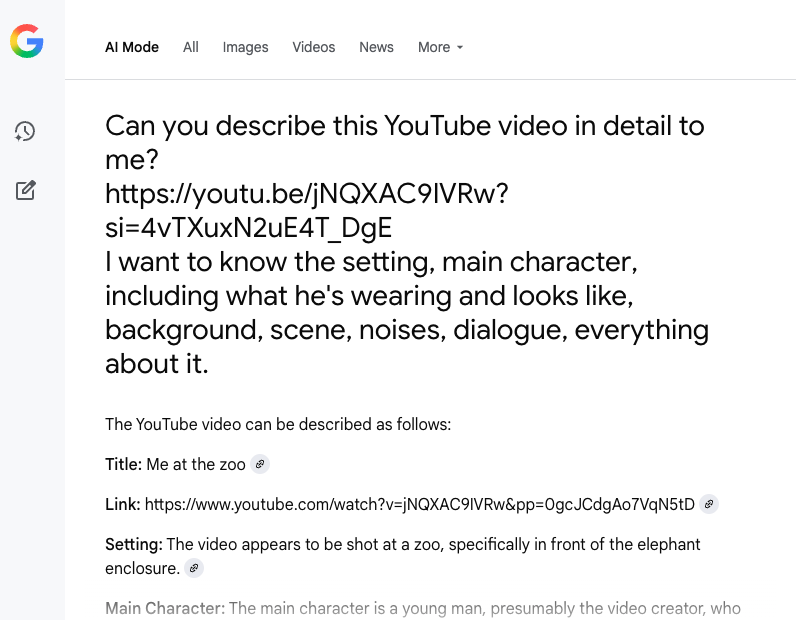
Google Gemini 2.5 Pro is not currently capable of analyzing a URL, but Google AI Mode, the brand-new form of search that is quickly spreading across the US, is.

Here's the prompt I dropped into Google's AI Mode:

AI Mode URL analysis

(Image credit: Future)

Google AI Mode almost instantly returned with a detailed description, which I took and dropped into the Gemini Veo 3 prompt field.

I did do some editing, mostly removing phrases like "The video appears..." and the final analysis at the end, but otherwise, I left most of it and added this at the top of the prompt:

"Let's make a video based on these details. The output should be 4:3 ratio and look like it was shot on 8MM videotape."

It took a while for Veo 3 to generate the video (I think the service is getting hammered right now), and, because it only creates 8-second chunks at a time, it was incomplete, cutting off the dialogue mid-sentence.

Still, the result is impressive. I wouldn't say that the main character looks anything like Karim. To be fair, the prompt doesn't describe, for instance, Karim's haircut, the shape of his face, or his deep-set eyes. Google's AI Mode's description of his outfit was also probably insufficient. I'm sure it would have done a better job if I had fed it a screenshot of the original video.

Note to self: You can never offer enough detail in a generative prompt.

8 seconds at a time

The Veo 3 video zoo is nicer than the one Karim visited, and the elephants are much further away, though they are in motion back there.

Veo 3 got the film quality right, giving it a nice 2005 look, but not the 4:3 aspect ratio. It also added archaic and unnecessary labels at the top that thankfully disappear quickly. I realize now I should have removed the "Title" bit from my prompt.

The audio is particularly good. Dialogue syncs well with my main character and, if you listen closely, you'll hear the background noises, as well.

The biggest issue is that this was only half of the brief YouTube video. I wanted a full recreation, so I decided to go back in with a much shorter prompt:

Continue with the same video and add him looking back at the elephants and then looking at the camera as he's saying this dialogue:

"fronts and that's that's cool." "And that's pretty much all there is to say."

Veo 3 complied with the setting and main character but lost some of the plot, dropping the old-school grainy video of the first generated clip. This means that when I present them together (as I do above), we lose considerable continuity. It's like a film crew time jump, where they suddenly got a much better camera.

I'm also a bit frustrated that all my Veo 3 videos have nonsensical captions. I need to remember to ask Veo 3 to remove, hide, or put them outside the video frame.

I think about how hard it probably was for Karim to film, edit, and upload that first short video and how I just made essentially the same clip without the need for people, lighting, microphones, cameras, or elephants. I didn't have to transfer footage from tape or even from an iPhone. I just conjured it out of an algorithm. We have truly stepped through the looking glass, my friends.

I did learn one other thing through this project. As a Google AI Pro member, I have two Veo 3 video generations per day. That means I can do this again tomorrow. Let me know in the comments what you'd like me to create.

You might also like


source https://www.techradar.com/computing/artificial-intelligence/i-used-veo-3-to-recreate-the-first-youtube-video-and-the-results-are-almost-too-good

'VPNs are fragile and limited' - startup wants to replace business virtual private networks with physical plug-and-play device


  • Forget clunky VPN routers - Jumpbox pocket-sized tool promises encrypted remote access in seconds
  • VPNs are fragile, says Remote.It - plug-and-play approach can fix that
  • Jumpbox delivers centralized remote access without exposing devices to the public internet

SaaS network firm Remote.It has introduced a new hardware-based alternative to traditional business VPN tools.

Developed in collaboration with IoT connectivity firm Embedded Works, Jumpbox aims to reduce reliance on VPNs by offering plug-and-play remote access without the need for manual network configuration.

“VPNs are fragile and limited," noted Remote.It CEO Ryo Koyama, "each endpoint can only be connected to one VPN at a time (or you have to embed a series of VPNs so multiple networks can communicate). But that makes the whole network even more dependent on a series of configurations being correct and updated.”

Challenging conventional VPNs

Koyama argues Jumpbox offers a more stable and centralized alternative, allowing administrators to monitor and manage multiple networks simultaneously.

“The Jumpbox is designed as an always there connection that doesn't have the same weak points VPNs have," he claimed. "With Jumpbox an admin could be monitoring, updating, troubleshooting multiple network connections at the same time,"

Despite this claim, the broader market has not fully abandoned VPNs, with many businesses investing in the best VPN router for added control and flexibility.

Remote.It’s approach hinges on replacing these with a zero-configuration setup that works out of the box, featuring 2 USB 2.0 ports, 2 USB 3.0 ports, 1 Gigabit Ethernet port, 1 HDMI, and a 3.5mm audio jack, all powered by a 1.8 GHz CPU and support for Wi-Fi 6, 5G, Bluetooth, Starlink and a 64GB microSD.

The Jumpbox comes pre-loaded with Remote.It’s software and offers encrypted access via cellular networks, making it particularly appealing to companies managing devices at dispersed sites.

While Remote.It has not explicitly branded the Jumpbox as a ZTNA solution, it does offer centralized control, encrypted tunnels, and out-of-band management capabilities like many similar services, as well as the ability to access devices without exposing them to the public internet, an important principle in Zero Trust frameworks.

“There is a vast number of Internet and IoT connected devices that don't have any remote management systems," noted Andy Do, President of Embedded Works, "and for those that do, it is usually very costly to purchase an annual license per device.”

This device, currently available on Amazon for $99.99, comes with a one-year Remote.It Business Plan and also offers unlimited device access and technical support.

You might also like


source https://www.techradar.com/pro/vpns-are-fragile-and-limited-startup-wants-to-replace-business-virtual-private-networks-with-physical-plug-and-play-device

Critical security flaw could leave over 100,000 WordPress sites at risk


  • A flaw in TI WooCommerce Wishlist allows threat actors to upload arbitrary files
  • Since the files can be malicious, they could fully take over a website
  • A patch is not yet released, so users should take care

A critical-severity vulnerability in a popular WordPress plugin is possibly exposing hundreds of thousands of websites to different risks, including complete website takeover.

Security researchers from Patchstack have claimed TI WooCommerce Wishlist carried an arbitrary file upload flaw, which allowed actors to upload malicious files to the underlying server without authentication.

The vulnerability is now tracked as CVE-2025-47577, and has a severity score of 10/10 (critical).

Reading the calendar

The TI WooCommerce Wishlist plugin is an extension for WooCommerce stores that allows users to create and manage wishlists, saving and sharing their favorite products.

Besides the social sharing options, the plugin comes with AJAX-based functionality, multiple wishlist support in the premium version, email notifications, and more.

According to The Hacker News, it has more than 100,000 active installations, meaning that the potential attack surface is rather large. To make matters worse, these are e-commerce sites, where visitors usually come to spend money, further compounding the risk.

At press time, the newest version of the plugin is 2.9.2, last updated six months ago. Since the patch has not yet been released, users who fear an attack are advised to disable and remove the plugin until a fix is released.

The silver lining here is that successful exploitation is only possible on websites that also have the WC Fields Factory plugin installed and running, and the integration is enabled on the TI WooCommerce Wishlist plugin.

WC Fields Factory is a free WooCommerce plugin that allows store owners to add custom fields to product pages, variations, checkout forms, and the WordPress admin interface.

It supports different field types such as text, number, email, date picker, and more. The plugin allows for dynamic pricing adjustments based on field inputs, field visibility rules, and role-based access controls, as well, and it offers a drag-and-drop form designer.

You might also like


source https://www.techradar.com/pro/security/critical-security-flaw-could-leave-over-100-000-wordpress-sites-at-risk

DJI Osmo 360 leak suggests Insta360 rival could land sooner than expected – and it may be joined by the tiny DJI Osmo Nano


  • A new leak claims the DJI Osmo 360 will be launched in July 2025
  • The "DJI Osmo Nano" has mentioned in a recent FCC filing
  • Tariff uncertainty could mean US launches are postponed

DJI’s long-rumored 360 camera may be only weeks away from release – and it might not be the only action camera the brand has in store for us this summer.

In a report published today, Chinese website IT Home claims that the DJI Osmo 360, DJI’s first consumer 360 camera, will be launched in July 2025. Aside from that rather vague and tantalizing rumor, the news piece is light on new info – but given that some commentators have speculated that this camera would never see the light of day at all, it’s something.

We’ve already heard plenty of rumors about the Osmo 360, however: it was first mentioned in an FCC filing back in October 2024, with the first leaked shots hitting the internet in February 2025, followed by a claim that it would use 1/1.3-inch image sensors in March.

And then, earlier this month, dozens of images apparently showing the camera design were leaked alongside snaps of its instruction manual, which revealed details such as a 1,950mAh battery, on-board touchscreen and compatibility with the DJI Mimo mobile app.

If this rumor of a July launch turns out to be true, we’d certainly welcome another challenger to take on the superb Insta360 X5.

With a full-blooded GoPro Max 2 apparently suffering repeatedly delays, and GoPro’s refreshed Max offering only modest updates over the 2020 original, Insta360 currently dominates our guide to the best 360 cameras. Some stiffer competition is sorely needed, and that's hopefully en route according to these fresh rumors.

And what of the DJI Osmo Nano?

The DJI Action 2 action camera on a table with its display module

The modular DJI Action 2: could the Osmo Nano be bringing back this approach? (Image credit: Future)

The Osmo 360 may not be DJI’s only upcoming camera launch of the summer, either. The online rumor mill is also speculating about an ultra-compact action camera called the DJI Osmo Nano, following its appearance in two listings with the FCC.

The Osmo Nano appears to be a return to the modular design of the DJI Action 2, which allowed tiny separate components to be magnetically attached to each other.

While the small size and clever design did impress, DJI subsequently abandoned the modular approach, opting for a GoPro Hero-style design with its more recent Osmo Action cameras. The Nano could be a return to that approach.

We’ve also heard that a DJI Osmo Action 6 will be released this year, replacing the superb Osmo Action 5 as the brand’s leading ‘standard’ action camera. So, it seems that DJI has a busy few months ahead of it.

One thing we do wonder about, however, is whether all (or any) of these cameras will make it to the US or not. Citing uncertainty over the tariff situation, DJI has postponed launching its new Mavic 4 Pro flagship camera drone in the States – could these action camera in line for a similar fate until some stability returns? It seems we won't have to wait long to find out.

You might also like


source https://www.techradar.com/cameras/action-cameras/dji-osmo-360-leak-suggests-insta360-rival-could-land-sooner-than-expected-and-it-may-be-joined-by-the-tiny-dji-osmo-nano

Wednesday, May 28, 2025

New OLED screen with a speaker in every pixel promises sound as precise as OLED's contrast


  • Each OLED pixel can be a sound source too
  • No need for conventional speakers and no increase in thickness
  • Could be used for in-car displays, smartphones and headsets

For years now the TV industry has been thinking about pixels: how to make them brighter, how to make them smaller, how to put them together in the best possible way. And now there's a new push: how to make them sound.

As spotted by Science Daily, researchers at Pohang University of Science and Technology (POSTECH for short) have created a 13-inch OLED panel where every pixel makes sound as well as light.

And that tech could one day deliver multi-channel sound with incredible precision – without requiring speaker drivers.

Pixels should be heard as well as seen

A diagram showing how an OLED with pixel-based local sound could work

(Image credit: Wiley / POSTECH )

As Science Daily reports (hat tip to Notebookcheck), the team have called their invention 'Pixel-Based Local Sound OLED technology'. And as they explain, the problem with TV audio is that it's really hard to get accurate positional sound with conventional speakers.

"The core issue is that traditional exciters – devices that vibrate to produce sound – are large and heavy, making it difficult to deploy multiple units without interference or compromising the OLED's thin design," the researchers say. "Additionally, sound crosstalk between multiple speakers leads to a lack of precise control over localized audio."

Their solution was to embed piezo-electric exciters within the OLED display frame. "These piezo exciters, arranged similarly to pixels, convert electrical signals into sound vibrations without occupying external space. Crucially, they are fully compatible with the thin form factor of OLED panels."

That enables each pixel to become an independent sound source, and the team says that they were able to completely eliminate crosstalk – so that sounds coming from different parts of the display didn't interfere with one another.

The applications of the technology go beyond TVs. One suggestion is that in-car displays could send different audio to different people, for example by giving vocal directions to the driver while the passenger listens to music. And in phones or headsets the audio could change as the head, hand or device moves.

According to Professor Su Seok Choi, "This technology has the potential to become a core feature of next-generation devices, enabling sleek, lightweight designs in smartphones, laptops, and automotive displays – while delivering immersive, high-fidelity audio."

The "has the potential" bit is key, however: this is a proof of concept, not a product – and there's a big difference between producing audio and producing excellent audio. And of course what works in a 13-inch prototype may prove much more difficult to achieve in panels of larger sizes.

There's also the question of cost – so while the announcement is definitely exciting I think the best soundbars can breathe easy for a good few years yet.

You might also like


source https://www.techradar.com/televisions/new-oled-screen-with-a-speaker-in-every-pixel-promises-sound-as-precise-as-oleds-contrast

Apple’s rumored iOS 19 gaming app is exciting for Apple fans, but it won’t tempt gamers from Windows


  • Apple may be developing a dedicated gaming app for iOS, macOS and more
  • The app will contain things like achievements, leaderboards and messages
  • It could be announced at WWDC in June

For years, Apple has been trying to convince the world that it’s taking gaming seriously, and with the popularity of IOS gaming and the appearance of AAA titles like Cyberpunk 2077 on macOS, there’s some truth to the company’s assertion.

Just in case you needed more convincing, there’s a new rumor from Bloomberg reporter Mark Gurman that Apple will soon launch a dedicated gaming app in iOS 19 to woo players to its platforms. As a Mac-owning gamer, I'm cautiously optimistic about the rumors – even if we still need more affordable hardware and games before it gets anywhere close to being a Windows competitor.

If you missed the news, the app will apparently “serve as a launcher for titles and centralize in-game achievements, leaderboards, communications and other activity,” Gurman said, adding that it will also feature “editorial content from Apple about new titles, offer access to the App Store’s game section and promote [Apple] Arcade.” It’s expected to be revealed on iOS, macOS, iPadOS and tvOS as soon as Apple’s WWDC 2025 event on June 9.

The move makes sense – after all, the iPhone is a phenomenally popular gaming platform, and announcing a move like this at WWDC could help to cement the popularity of iOS 19 before it’s even out the door. Apple might also be hoping that it will tempt more gamers to switch from Windows to the Cupertino firm’s platforms – but on this point, I’m not entirely convinced.

Destination of choice for gamers

A Mac gaming presentation during WWDC 2022

(Image credit: Apple)

This app might work well in iOS 19, where gaming tends to be a little more casual than on desktop computers. But things might look very different on macOS.

As a gamer who also owns a Mac, I’ve been encouraged over the last few years by Apple’s strides in the gaming world. It’s nowhere near parity with Windows yet, but the situation today is much better than it was just a few years ago.

For a long time, the problem was the chicken-and-egg nature of Mac gaming. Gamers didn’t want to switch to macOS due to the lack of games, and developers didn’t want to bring games to the Mac due to the lack of players. That’s slowly starting to change, with big-name titles like Cyberpunk 2077, Assassin’s Creed Shadows, and Baldur’s Gate 3 helping to dispel the idea that the Mac is a gaming wasteland.

However, the impact of a dedicated gaming app will likely be limited. Beyond my contention that gamers care more about hardware and game availability than launcher apps, Gurman is also skeptical, saying that “testers of the software say it probably won’t change the perception among players and makers of high-end titles.”

Any advance for gaming on Apple’s platforms is welcome in my eyes, and this app could help by making gaming more prominent among users of iOS and macOS. But what’s really needed – on the Mac at least – is a greater number of attention-grabbing titles and more affordable access to components that offer exceptional gaming performance.

Until that happens, Windows will always be the destination of choice for gamers.

You might also like


source https://www.techradar.com/phones/ios/apples-rumored-ios-19-gaming-app-is-exciting-for-apple-fans-but-it-wont-tempt-gamers-from-windows

Tuesday, May 27, 2025

Here's the thing Apple gets right about platforms that Samsung would be smart to copy

I spend most of my time using an excellent iPhone 16 Pro Max, which means I get to live most of my existence using the expertly tailored iOS 18 experience. Sometimes, though, I use the equally fantastic Samsung Galaxy S25 Ultra, a flagship phone now running Android 15 and OneUI 7.

In many ways, the S25 Ultra is equal to the iPhone; the platforms tend to look and work in more or less similar ways. There is, though, one significant way in which they differ and, to be honest, I'm tired of it.

As you may be aware, unless you own a Google Pixel Phone, you're unlikely to get a pure Android experience. Third-party partners, such as OnePlus, Motorola, and Samsung, customize their skins for the platform.

For some, that's the beauty of Android: it can be many things to many people, and in the case of Samsung, this expresses itself in the form of OneUI.

It's a lovely platform that now offers things such as deeply integrated Samsung Galaxy AI, Samsung Health, and the lively Now Brief Widget, which offers information and chatty aphorisms like, "The day rolls on."

Duplication of effort

Where the experience is less grand, though, is in duplication. For every app where Google and Android ostensibly have you covered, think, Photos, Contacts, and Chrome; Samsung's OneUI has a duplicate. Some, like Internet and Contacts, are easy to ignore.

Others, like "Gallery," are less so because they include core features like Generative AI image editing. Some, like Sketch to Image, which allows you to scribble on a photo to add elements like a photo-realistic bird flying or a dog sitting next to you, are fun if not full of utility. But Gallery pales in comparison to Google Photos' powerful search capabilities. When I need to find an image, I will always go there.

There's also Google's critical Play Store, but it doesn't have all the Samsung Apps you need – that would be the "Galaxy Store."

I've learned to live with most of this duplication, but the other day I stumbled into a bit of doppleganger mess that tested my patience.

In the hours before an industry event, I received an email on my iPhone with a link to add the invite to my digital wallet. I clicked on the link, thinking it would open Apple Wallets, but I was thrust into a Google login. It was then that I realized the link was for Google Wallet. Everyone's Wallet app icon looks alike because there's really only one visual metaphor for a wallet: a stacked group of credit cards.

I picked up the Samsung Galaxy S25 Ultra, opened the email, and selected the Google Wallet icon. That's when I discovered, to my surprise, that Google Wallet is not pre-installed. I installed it and then signed in to my Google account.

I then used the global Google search on my S25 ultra to find the Wallet app, and I got three results:

  • Samsung Wallet
  • Google Pay
  • Google Wallet

Note how Samsung's Wallet appears first; that's no accident. Someone not paying attention might open that link first and then search in vain for the invite or plane ticket they just added.

On an iPhone, this would never happen. You get one utility app, though, you can certainly add more if you choose. But that should be the default: Core platform apps only, and not ones that align only with your specific brand.

I get that Samsung wants to build an ecosystem, but as a member of the Android family, it should accept that it will never own that ecosystem. There will always be this duplication problem, unless Samsung stops trying to copy these apps and lets Google and Android take the wheel.

After all, are we buying Samsung Galaxy phones for OneUI apps or, ultimately, for that hardware experience, including things like the cameras and a lovely, nearly bezel-free screen?

Samsung Wallet and Google Wallet

(Image credit: Future)

1+1 = too much

I know that Samsung is quite proud of its flavor of AI, but to be honest, I don't think it can keep up with the OpenAIs and Googles of the world. As it stands, the best bits of the Samsung Galaxy S25 Ultra AI experience are from Google (Gemini).

For some, my perspective is the opposite of what they want. They love choice, and the fact that all Android Phones are subtly or frustratingly different somehow pleases them. That the Photos, Internet, or Wallet apps are different on every platform is, they think, an exciting plus.

Sure, you keep thinking that. I, on the other hand, will dream of the OneUI update that is paper-thin and combines all the fundamental and best bits of Android while only adding features Google wouldn't do otherwise.

It is ironic that Samsung calls its platform "OneUI" when in fact the experience is the combination of two UIs living under one flagship roof. It's still too crowded a space, and I would like Samsung to kick a few duplicate tenants out.

You might also like


source https://www.techradar.com/phones/samsung-galaxy-phones/heres-the-thing-apple-gets-right-about-platforms-that-samsung-would-be-smart-to-copy

Aluminum and the iPhone 17 Air sounds like a poor recipe for clumsy people like me

At first, I wasn’t sold on the idea of titanium being used in phone chassis, dismissing it as a bit of a marketing gimmick rather than a truly useful feature. But then I spent time with the iPhone 15 Pro Max, Samsung Galaxy S24 Ultra, and then their successors, the iPhone 16 Pro Max and Galaxy S25 Ultra, made me a titanium convert

My 180-degree turn in opinion about titanium stems from my habit of not using cases for flagship phones, as part of my appreciation for slick industrial design. This doesn't mix with an inherent clumsiness and bad luck that often sees these expensive phones take a plunge towards hard floors and surfaces in one way or another.

Those with a stainless steel chassis would tend to chip, dent, and scratch, but the aforementioned titanium-sporting phones benefit hugely from the toughness of the metal and basically shrug off the accidental battering I give them.

So it’s my hope that more phones, including the likely upcoming Samsung Galaxy Z Fold 7 make use of titanium.

However, despite its toughness and relative lightness, the rumored iPhone 17 Air will eschew titanium for an aluminium frame, all with the idea of maximising thinness and lightness. We’ve heard this rumor a few times, with the latest tip coming from the Korean-language yeux112‘s blog.

The blog, which supposedly has insider or supply chain information, claims aluminum will be used for the frame of the iPhone 17 Air, as toughness takes a back seat in favour of lightness.

Leaving me alumi-numb

The iPhone 16 Pro Max and Samsung Galaxy S25 Ultra

(Image credit: Future)

Having recently been at a wedding, I’m all for thinner and lighter phones that can help me avoid unwanted bulges in my suit (stop laughing at the back). But I don’t want this to come at the expense of toughness, so the idea of aluminum in the iPhone 17 Air has me raising a wary eyebrow.

I also rather like the heft of iPhones; there’s just something reassuringly solid and premium with the older Pro models and their stainless steel chassis.

I’ve since embraced titanium for the larger Max phones as the lighter weight makes the larger phones easier to handle one-handed. But much lighter would run the risk of making these flagship Apple phones feel potentially cheaper than their list prices.

That being said, Apple can still be innovative from time to time, and I’d not be surprised if the Cupertino crew is working on some form of alloy or design that’ll thread the line between a super-light and thin phone and one that’ll not be ruined by the odd fall.

We’ve seen Apple do that with its Ceramic Shield glass, so perhaps we could see the advent of ‘Aluminium Armor’ with the iPhone 17 Air; time will tell, and it'll likely be at a September Apple event.

You might also like


source https://www.techradar.com/phones/iphone/aluminum-and-the-iphone-17-air-sounds-like-a-poor-recipe-for-clumsy-people-like-me

Cisco security flaw exploited to build botnet of thousands of devices


  • Sekoia researchers warn of new ViciousTrap botnet
  • So far, it compromised more than 5,000 dated Cisco routers
  • The devices are vulnerable to an old improper validation bug

A high-severity vulnerability plaguing old Cisco routers is being used to build a malicious, global botnet, experts have warned.

Cybersecurity researchers Sekoia published an in-depth report on the threat actor - dubbed ViciousTrap - which is using a vulnerability tracked as CVE-2023-20118, to target Cisco Small Business RV016, RV042, RV042G, RV082, RV320, and RV325 Routers.

This flaw, found in the web-based management interface, allows an authenticated, remote attacker to execute arbitrary commands on an affected device, made possible due to improper validation of user input within incoming HTTP packets.

PolarEdge's little brother

Unfortunately, Cisco won’t be patching the bug since the affected devices are past their end-of-life date, WNE Security reported.

The vulnerability allowed ViciousTrap to execute a shell script named NetGhost, “which redirects incoming traffic from specific ports of the compromised router to a honeypot-like infrastructure under the attacker's control allowing them to intercept network flows,” Sekoia explained.

So far, almost 5,300 devices, found in 84 countries around the world, were assimilated into the botnet. The majority of the victims are located in - Macau (850).

This is not the first time Sekoia is ringing the alarm on CVE-2023-20118. In late February 2025, TechRadar Pro reported Sekoia was warning about a botnet named PolarEdge, using the same vulnerability to target a range of devices from Cisco, ASUS, QNAP, and Synology. At the time, roughly 2,000 devices were said to have been affected.

For ViciousTrap’s work, all exploitation attempts came from a single IP address, the researchers further discovered, stating that the attacks started in March 2025. It was also said the threat actors repurposed an undocumented web shell previously used in PolarEdge attacks.

Although these things are always difficult to confirm, Sekoia believes the attackers are Chinese in origin.

Via The Hacker News

You might also like


source https://www.techradar.com/pro/security/cisco-security-flaw-exploited-to-build-botnet-of-thousands-of-devices

Another top employment website found exposing recruiter email addresses


  • A major Indian job site was leaking recruiter emails
  • The problem stemmed from a bug in the Naukri API
  • The hole was quickly plugged, but users should be aware of scams

One of the most popular and widely used job portals in India has reportedly been found leaking recruiter email addresses.

A security researcher named Lohith Gowda recently discovered a vulnerability in Naukri’s API for Android and iOS apps, which exposed the recruiters’ email addresses when they were viewing profiles of potential candidates.

Speaking to TechCrunch, Gowda explained what the dangers of this vulnerability were: “The exposed recruiter email IDs can be used for targeted phishing attacks, and recruiters may receive excessive unsolicited emails and spam."

Save up to 68% for TechRadar readers

TechRadar editors praise Aura's upfront pricing and simplicity. Aura also includes a password manager, VPN, and antivirus to make its security solution an even more compelling deal.

Preferred partner (What does this mean?)View Deal

2FA codes and session tokens

Gowda further stressed that the email IDs can be added to different spam lists and public breach databases, which are sometimes picked up by scraping bots. This, in turn, can lead to automated bot abuse and various scams.

Relevancy and a sense of urgency are key to a successful phishing email.

An attacker might reference an ongoing hiring campaign, a candidate's resume, or a job platform the recruiter uses, to make the email feel timely and legitimate.

Urgency, on the other hand, is how threat actors force the victims into making rash decisions that they later regret.

In this case, these could be claims of a top candidate being about to accept another offer or interview access links that are expiring.

After discovering the flaw, Gowda reached out to Naukri, who then plugged the leak. “All identified enhancements are implemented, ensuring our systems remain updated and resilient,” Alok Vij, IT infrastructure head at Naukri’s parent company InfoEdge, confirmed to TechCrunch. “Our teams have not detected any usual activity that affects the integrity of user data.”

Naukri.com is one of the most popular Indian job sites. According to SimilarWeb, it had more than 28 million unique monthly visits in April 2025, and ranks as the number one job and employment website in the country.

You might also like


source https://www.techradar.com/pro/security/another-top-employment-website-found-exposing-recruiter-email-addresses

Secure by design: the MOD's honest take

The Ministry of Defence (MOD) recently published a document on 'Secure by Design' challenges that represents something we rarely see in government cybersecurity: a transparent acknowledgment of the complexities involved in implementing security from first principles.

Secure by design is a fundamental approach that embeds security into systems from the very beginning of the design process as opposed to treating it as a bolt-on feature later in development.

Having spent years advocating for the human element in security, it's refreshing to see an official recognition that technical controls are only as effective as the people implementing them.

Addressing the Security Skills Challenge

The MOD's first identified problem is "How do we up-skill UK defense in 'Secure by Design'?"

Their acknowledgment that effective implementation requires a "one team" approach across UK defense reflects the reality that security cannot be siloed within technical teams.

This aligns perfectly with what I've observed in organizations with mature security cultures—security becomes everyone's responsibility, not just the security department's concern.

The Knowledge Distribution Problem

Perhaps most intriguing is problem two: "How does 'Secure by Design' account for unevenly distributed information and knowledge?"

The MOD correctly identifies that information asymmetry exists for various legitimate reasons. What makes this assessment valuable is the recognition that not all information-sharing barriers stem from poor security culture; some exist by design and necessity.

Imagine a family planning a surprise birthday party for their grandmother. Different family members have different pieces of information that they intentionally don't share with everyone:

The daughter knows the guest list and has sent invitations directly to each person, asking them not to discuss it openly on family group chats,

The son has arranged the venue and catering, with specific dietary requirements for certain guests,

The grandchildren are handling decorations and have a theme they're working on,

And most importantly—nobody tells grandmother anything about any of this.

This isn't because the family has poor communication skills or doesn't trust each other. These information barriers exist by design and necessity to achieve the goal of surprising grandmother. If everyone shared everything with everyone else, the surprise would be ruined.

The MOD's approach

In the MOD's security context, this is similar to how:

Certain threat intelligence can't be shared with all suppliers because doing so might reveal intelligence-gathering capabilities,

Suppliers can't share all their proprietary technology details even with clients like the MOD, as they need to protect their competitive advantage,

Specific security controls might be kept confidential from general staff to prevent those controls from being circumvented.

These aren't failures of security culture—they're intentional compartmentalization that sometimes make security work possible in the first place. The challenge isn't eliminating these barriers but designing systems that can function effectively despite them.

This reflects the nuanced reality of human behavior in security contexts. People don't withhold security information solely due to territoriality or negligence; often, legitimate constraints prevent the ideal level of transparency. The challenge becomes developing systems and practices that can function effectively despite these inherent limitations.

The Early Design Challenge

The third problem addresses a familiar paradox: how to implement security at the earliest stages of capability acquisition when the capability itself is barely defined.

In other words, it's like trying to build a high-tech security system for a house when you only have a rough sketch of what the house might eventually look like - you know you need protection, but it's difficult to plan specific security measures when you're still deciding how many doors and windows there will be, what valuables will be stored inside, or even where the house will be located. As the MOD puts it, at this stage a capability might be "little more than a single statement of user need."

This connects directly to how humans approach risk management. When primary objectives (delivering military capability) compete with secondary concerns (security), practical compromises inevitably emerge. The MOD's candid acknowledgment that "cyber security will always be a secondary goal" reflects a pragmatic understanding of how priorities function in complex organizations.

Through-Life Security

Problem four addresses perhaps the most demanding human aspect of security: maintaining security rationale and practice across decades of a capability's lifespan. With defense platforms potentially remaining operational for 30+ years, today's security decisions must make sense to tomorrow's engineers.

The question of continuous risk management becomes particularly relevant as organizations encounter new threats over their extended lifespans. How human operators interpret and respond to evolving risk landscapes determines the long-term security posture of these systems.

Building a Collaborative Security Culture

The MOD recognizes that 'Secure by Design' implementation isn't merely a technical challenge but fundamentally about collaboration among people across organizational, disciplinary, and national boundaries.

The MOD's approach suggests a shift toward a more mature security culture — one that acknowledges limitations, seeks external expertise, and recognizes the complex interplay between human factors and technical controls. Their openness about needing help from academia and industry demonstrates a collaborative mindset essential for addressing complex security challenges.

This collaborative approach to security culture stands in stark contrast to the traditional government tendency toward self-sufficiency. By explicitly inviting external perspectives, the MOD demonstrates an understanding that diverse viewpoints strengthen security posture rather than compromising it.

Security isn't about having all the answers—it's about creating the conditions where people can collaboratively develop appropriate responses to ever-changing threats.

We've compiled a list of the best identity management software.

This article was produced as part of TechRadarPro's Expert Insights channel where we feature the best and brightest minds in the technology industry today. The views expressed here are those of the author and are not necessarily those of TechRadarPro or Future plc. If you are interested in contributing find out more here: https://www.techradar.com/news/submit-your-story-to-techradar-pro



source https://www.techradar.com/pro/secure-by-design-the-mods-honest-take

Unlocking intelligent agents through connected data

Agentic AI is one of the latest concepts in artificial intelligence, now gaining real traction beyond its early buzz. Ongoing advancements in Agentic AI are accelerating the development of autonomous business systems, building on the achievements of machine learning.

Operating as an independent ‘agent’, this technology is equipped to make informed decisions based on the multimodal data and algorithmic logic, and can then ‘learn’ and evolve through experience.

Even more exciting is its capacity to act independently. It’s this unique ability to adapt, plan, and carry out complex tasks without human oversight that distinguishes Agentic AI from earlier generations of AI tools.

In supply chains, for instance, AI agents can track market activity and historical demand trends to forecast inventory needs and implement measures to avoid shortages, such as by automating parts of the restocking processes. These agents shift their behavior in response to changing market conditions, boosting efficiency and performance. It's therefore no surprise that 26% of business leaders report their organizations are beginning to shape strategic approaches around Agentic AI.

However, as great as it sounds to outsource such tasks to Agentic AI, we also need to err on the side of caution. For all its autonomous power, how can the actions and outputs of AI agents be fully trusted? If we rely on Agentic AI to complete sophisticated tasks on its own, how do we ensure its decisions are truly grounded in what’s happening in the real world, or in the enterprise’s view of the world?

In the same way our brains use observation and extra inputs to draw conclusions, AI agents need to rely on a lot of external sources and signals to enhance their reasoning capabilities.

This need can be met by solutions and platforms that collect and present data in a way that’s accessible and retrievable. Here’s how:

The trust challenge in autonomous AI systems

As discussed, what sets Agentic AI apart from other AI systems is its ability to act autonomously, not just engage in a linear conversation. The complexity of the tasks agents complete typically requires them to refer to multiple, dynamic external sources. As a result, the risk of something going wrong automatically increases. For example, you might trust a chatbot to provide you with an update on the status of a claim or refund, but would you feel as trusting when giving an AI agent your credit card details to book a flight for you?

Away from conversational AI, task-based agents plan and change actions depending on the context they’re given. They delegate subtasks to the various tools available through a process often referred to as “chaining” (the output of one action becomes the input for the next). This means that queries (or tasks) can be broken down into smaller tasks, with each requiring access to data in real-time, processed iteratively to mimic human problem-solving.

The chain effect (in which decisions are made) is informed by the environment that’s being monitored, i.e., the sources of data. As a result, explainable and accurate data retrieval is required at each step of the chain for two reasons. Firstly, users need to know why the AI agent has landed on a particular decision and have visibility of the data source it’s based on.

They need to be able to trust that the action is, in fact, the most effective and efficient. Secondly, they need to be able to optimize the process to get the best possible result each time, analysing each stage of the output and learning from any dissatisfactory results.

To trust an agent to complete sophisticated tasks based on multiple retrieval steps, the value of the data needed to support the decision-making process multiplies significantly.

The need to make reliable enterprise data available to agents is key. This is why businesses are increasingly recognising the power of graph database technology for the broad range of retrieval strategies it offers, which in turn multiply the value of the data.

How graph technology strengthens AI reasoning

As Agentic AI drives decisions from data, the insights underpinning these decisions must be accurate, transparent, and explainable – benefits that graph databases are uniquely optimized to deliver. Gartner already identifies knowledge graphs as an essential capability for GenAI applications, as GraphRAG (Retrieval Augmented Generation), where the retrieval path includes a knowledge graph, can vastly improve the accuracy of outputs.

The unique structure of knowledge graphs, comprised of ‘nodes’ and ‘edges’, is where higher-quality responses can be derived. Nodes represent existing entities in a graph (like a person or place), and edges represent the relationship between those entities – i.e., how they connect to one another. In this type of structure, the bigger and more complex the data, the more previously hidden insights can be revealed. These characteristics are invaluable in presenting the data in a way that makes it easier for AI agents to complete tasks in a more reliable and useful way.

Users have been finding that GraphRAG answers are not only more accurate but also richer, speedier, more complete, and consequently more useful. For example, an AI agent addressing customer service queries could offer a particular discounted broadband package based on a complete understanding of the customer, as a result of using GraphRAG to connect disparate information about said customer. How long has the customer been with the company? What services are they currently using? Have they filed complaints before?

To answer these questions, nodes can be created to represent each aspect of the customer experience with the company (including previous interactions, service usage, and location), and edges to show the cheapest or best service for them. A fragmented and dispersed view of the data could lead to the agent offering up a discounted package when it was not due, leading to cost implications for the business.

As mentioned by the CEO of Klarna, “Feeding an LLM the fractioned, fragmented, and dispersed world of corporate data will result in a very confused LLM”. But the outcome is very different when data is connected in a graph: Positive results have been reported by the likes of LinkedIn’s customer service team, who have reduced median per-issue resolution time by 28.6% since implementing GraphRAG.

Why connected data is key to Agentic AI readiness

With every iteration, the LLMs behind AI agents are advancing quickly, and agentic frameworks are making it easier to build complex, multi-step applications. The next vital move is to make enterprise data as rich, connected, and contextually aware as possible, so it's fully accessible to these powerful agents.

Taking this step allows businesses to unlock the full value of their data, enabling agents that are not only more accurate and efficient but also easier to understand and explain. This is where the integration of Agentic AI and knowledge graphs proves transformational. Connected data gives agents the context they need to think more clearly, generate smarter outputs, and have a greater impact.

We've compiled a list of the best survey tools.

This article was produced as part of TechRadarPro's Expert Insights channel where we feature the best and brightest minds in the technology industry today. The views expressed here are those of the author and are not necessarily those of TechRadarPro or Future plc. If you are interested in contributing find out more here: https://www.techradar.com/news/submit-your-story-to-techradar-pro



source https://www.techradar.com/pro/unlocking-intelligent-agents-through-connected-data

EU Court gives the Dutch the green light to pursue Apple App Store anti-trust case

The European Court of Justice says the Netherlands can go after Apple over its App Store commissions. source https://www.techradar.com/pro...